
Which HVAC System Is Best for a Multifamily Building?

Choosing the best HVAC system for a multifamily building depends on your property’s layout, utility setup, ventilation needs, and long-term operating goals. The right system can affect energy efficiency, maintenance costs, tenant comfort, and overall property performance.
Common multifamily HVAC systems include:
- Centralized hydronic systems
- VRF systems
- Water source heat pumps
- PTAC and VTAC units
- Ducted split systems
- Ductless mini-splits
The best option usually comes down to a few core factors:
- Building size and height
- Available mechanical, closet, or roof space
- Existing ductwork or PTAC sleeves
- Tenant billing structure
- Humidity control and ventilation needs
- Retrofit limitations and electrification plans
This guide compares the most common HVAC systems for apartment buildings and multifamily properties, including where each system works best, what tradeoffs to expect, and which factors matter most before you request quotes.
A-C Air Care supports multifamily owners across Central Maryland and the DC area with heating and cooling solutions tailored to each property’s needs. Start by reviewing your building constraints first, since they can quickly narrow your HVAC options.
The Pre-Design Checklist: How to Quickly Narrow Your Multifamily HVAC Options
A 12-unit garden-style in Elkridge with no mechanical room needs a different engineering approach than a 120-unit mid-rise with central plant space. Before requesting quotes, use this checklist to filter out systems that are not physically or financially realistic for your property.
- Building Scale: Garden walk-ups favor individual split systems, while high-rises often require centralized solutions to manage vertical distance.
- Existing Distribution: Reusing functional ductwork or PTAC sleeves saves capital but locks you into specific replacement categories.
- Structural Constraints: Limited roof space or weight capacity can eliminate large central chillers, favoring distributed condenser footprints.
- Utility Capacity: Switching to electric heat pumps often requires electrical panel upgrades that must be factored into the budget.
- Ventilation Strategy: Available shaft space determines if you can move from exhaust-only to balanced ventilation.
- Billing Goals: Tenant-paid utilities require independent systems with unit-level metering.
Once you identify these constraints, the best system for your multifamily project usually falls into a short list.
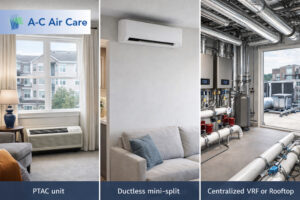
The Multifamily System Matrix: Which HVAC System Is Best for My Building?
The “most efficient” system is not always the best multifamily choice if it creates billing problems, maintenance bottlenecks, or humidity issues. While high SEER ratings look great in brochures, they fail if a single central issue impacts 50 units or leads to resident disputes over shared utility costs.
Use this breakdown to determine which HVAC system is best for multifamily buildings based on scale:
- Small (2 to 12 units): Ductless mini-splits or ducted split heat pumps. These offer the simplest tenant billing and require no central plant.
- Low-Rise (10 to 60 units): Split heat pumps for individual control. Consider Water Source Heat Pumps (WSHP) for shared loop efficiency.
- Mid to High-Rise: Centralized hydronic (4-pipe) for comfort or VRF for energy-efficient zoning in tight mechanical footprints.
System Type Snapshots
- Centralized Hydronic: Best for consistent comfort. It centralizes maintenance but increases installation complexity.
- VRF/VRV: Provides simultaneous heating and cooling. This can save 15 to 20 percent on monthly cooling costs through superior part-load performance.
- WSHP: Connects to a tempered loop. This allows you to bill tenants individually for fan and compressor use while leveraging a central boiler.
- PTAC/VTAC: Lowest upfront cost. These are noisier and have a shorter 7 to 10 year lifespan compared to centralized options.
- Unitary Forced-Air: Familiar maintenance and simple billing. Feasibility depends entirely on available closet and roof space.
Narrow your choice to two viable options based on these scales, then run a lifecycle cost analysis before committing to a final design.
Cost Breakdown: Which HVAC System Is Best for Multifamily ROI?
Upfront cost per door is only half the story. Maintenance, energy usage, and replacement cycles can flip the financial math over a ten-year hold. To decide which HVAC system is best for multifamily portfolios, owners must evaluate the total cost of ownership.
|
System Type |
Installed Cost (Per Door) |
Average Lifespan |
Maintenance Level |
|---|---|---|---|
|
PTAC/VTAC |
$1,500 – $3,500 |
7-10 Years |
Low |
|
Split Heat Pump |
$5,000 – $9,000 |
12-15 Years |
Moderate |
|
Water Source HP |
$6,000 – $11,000 |
15-20 Years |
Centralized |
|
VRF Systems |
$10,000 – $18,000 |
15-20 Years |
Specialized |
Four factors move these price ranges most:
- Condition of existing ducts or wall sleeves.
- Number of indoor zones or heads per unit.
- Difficulty of roof or mechanical room access.
- Necessity of electrical panel upgrades.
Unit-level systems like split heat pumps align with tenant meters for direct billing. For centralized loops or VRF systems, you must integrate thermal submeters or allocation software early. This planning prevents unrecoverable utility expenses later.
Future-proofing is now a regulatory necessity. Decarbonization mandates favor high-efficiency heat pumps, while the industry shift from R-410A to lower-GWP A2L refrigerants impacts equipment models and contractor training requirements. Federal and utility incentives often offset these upgrade costs. Before finalizing AC replacement or heating services, verify available rebates to maximize your long-term payback.
Why Residents Complain When the Thermostat Says 72 Degrees: The Tenant Experience Factor
Have you ever wondered why residents complain about comfort even when their unit hits its setpoint? In multifamily housing, true comfort is rarely just about temperature. Most grievances stem from high humidity, mechanical noise, or poor air quality – issues that directly impact resident retention and your maintenance budget.
When determining which HVAC system is best for multifamily, prioritize these four layers:
- Humidity Control: Oversized units satisfy thermostats too quickly, leaving moisture behind. Seek systems that maintain 45 to 55% relative humidity to prevent “sticky” air and mold risk.
- Balanced Ventilation: Standard exhaust fans pull unconditioned air through building gaps. Using Energy Recovery Ventilators (ERVs) provides a controlled air supply that protects the building envelope.
- Acoustics: Traditional PTAC units often exceed 60 decibels. Modern VRF or ductless systems offer nearly silent operation, supporting a premium atmosphere.
- Maintenance Access: System longevity depends on filtration. Design for easy access for MERV 13 filter changes.
Practical Takeaway: To avoid future liability, specify humidity targets, maximum decibel ratings, and a clear filter maintenance plan in your bid packages.
How to Choose the Right HVAC Strategy for Your Multifamily Property
Selecting an HVAC system for a multifamily property balances upfront costs against long-term Net Operating Income. While cheaper PTAC units save capital today, high-efficiency options like VRF or Water Source Heat Pumps often pay for themselves through reduced tenant turnover and lower utility waste. Success lies in matching mechanical capabilities to your specific billing goals and the physical footprint of the building.
Follow this five-step framework to move from research to a confident decision:
- Audit building constraints: Verify mechanical room space, roof load limits, electrical capacity, and existing distribution ductwork.
- Pick the category: Choose between centralized systems for simplified maintenance or unit-level systems for tenant-paid billing.
- Shortlist technology: Prioritize VRF or WSHP for larger buildings, and look at ducted splits or mini-splits for garden-style units.
- Compare bids on scope: Confirm every quote includes load calculations, a ventilation plan, and professional commissioning.
- Plan for maintenance: Establish a seasonal schedule that allows easy access for filter changes and coil cleaning.
In Central Maryland and the DC area, mixed-humid summers make humidity control and proper sizing essential for resident comfort. A-C Air Care offers site-specific assessments and estimates for multifamily projects to help you finalize your investment.
Frequently Asked Questions
What is the best HVAC system for a multifamily building: centralized or unit-by-unit?
The ideal choice depends on your building scale and billing strategy. Centralized systems are typically more efficient for mid-to-high-rise buildings, while unit-by-unit systems are better for smaller properties where tenants pay their own utilities. Centralized plants simplify major maintenance but require a strategy for allocating costs. Unit-level systems offer tenants more control but increase the total number of components your team must track across the property.
Is VRF or VRV technology worth the higher cost for apartments?
VRF systems are worth the higher initial investment for luxury or high-density apartments where zoning and quiet operation are priorities. These systems can reduce energy consumption by up to 30 percent through precise part-load operation. However, owners must account for service complexity. Because VRF technology is specialized, you should confirm your local contractor has specific training and a reliable supply chain for proprietary parts.
Can you submeter HVAC energy in a centralized system so tenants pay their share?
Yes, you can submeter energy usage in a centralized HVAC system using thermal energy meters or allocation software. These tools track the actual heating or cooling consumed by each unit so costs can be billed back to residents accurately. It is critical to plan for meter points during the design phase to avoid expensive retrofits. Many modern VRF and hydronic systems, like those serviced by A-C Air Care, offer integrated software solutions to simplify this billing process.
Why do tenants complain about PTAC units, and what are the better alternatives?
Residents often complain about PTAC units because of high noise levels, drafty operation, and inconsistent temperature control. These units also have a shorter lifespan, usually needing replacement every seven to ten years. Better alternatives include ductless mini-splits or ducted split heat pumps, which offer much quieter operation and better air filtration. If the building footprint allows, moving to a centralized loop can also solve these comfort issues while significantly improving energy efficiency.
How often should multifamily HVAC systems be professionally serviced?
Multifamily HVAC systems should be professionally serviced at least twice a year, ideally before the peak cooling and heating seasons. Regular inspections help identify small leaks or electrical issues before they lead to emergency unit-wide failures. For larger centralized plants, monthly checks on water chemistry and filter banks may be necessary. A proactive maintenance plan typically extends equipment life by 20 percent and keeps resident complaints at a minimum.